A Mighty Tree has fallen,
and the Birds who sheltered in its branches
Now have No Abode.
(Note: Click on any image you may want to enlarge.)

The title of our Website publication derives from the enigmatic statement just presented here above in bold italics. These words were traditionally spoken by members of the ancient community of Onitsha (who call themselves Ndi-Onicha, “Onitsha People”) when they learn that a reigning King (Obi) of Onitsha, Nigeria, has just died. When an event of this magnitude has occurred, its meanings must at first be conveyed in parable, only much later may the full facts become public knowledge. Onitsha people understand this immediatrely since one of the prime symbolic identifications of the Onitsha King is with a mighty tree.
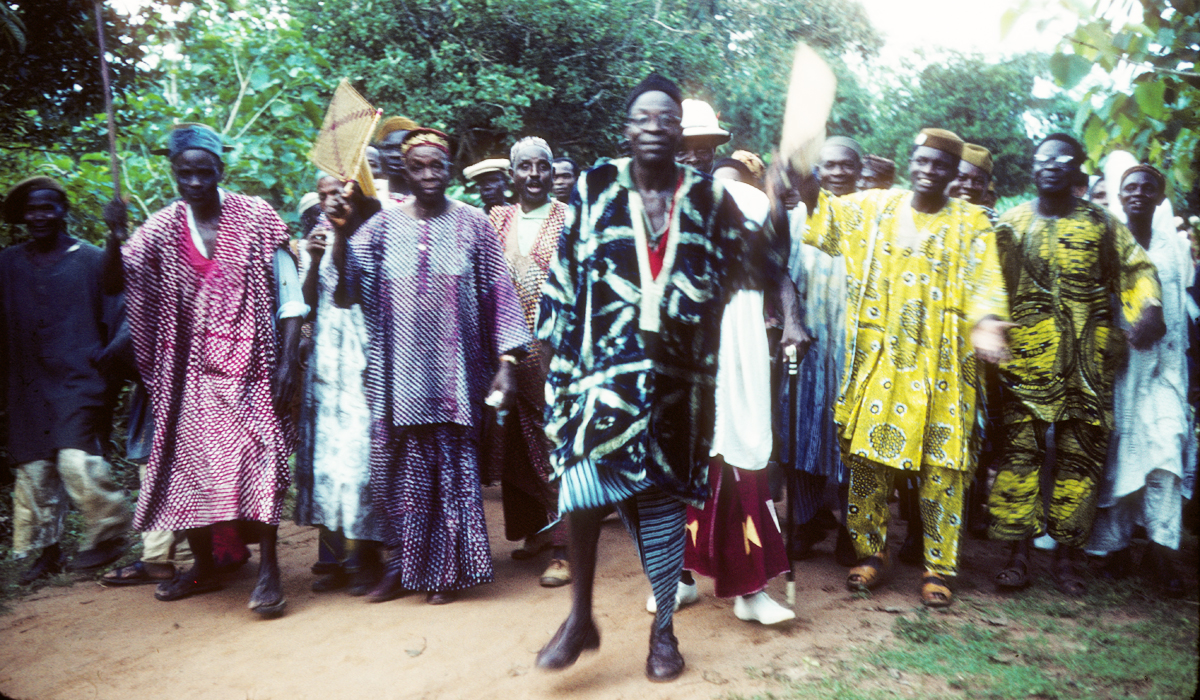
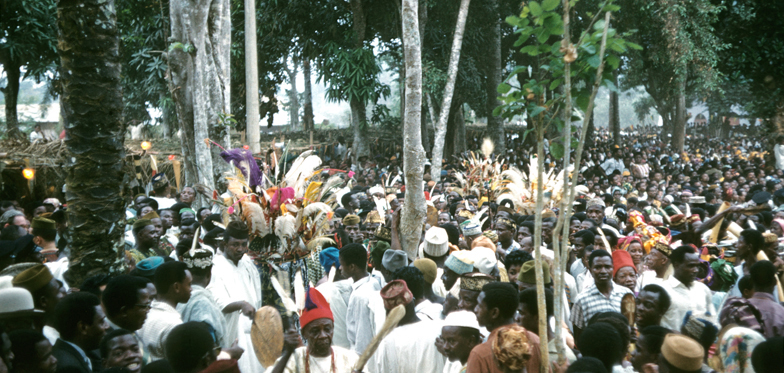
At left, Obi Okosi II Emerges from seclusion, October 1960.
This volume deals primarily with studies in, about, and variously related to the Nigerian city of Onitsha, primarily from the perspective of Richard and Helen Henderson, who lived there from 1960-62. We briefly returned, in 1992 — long after the Biafra Civil War of 1967-70 when it again became feasible for us to enter Nigeria; see Chapter Eight.
During and for some time after the Civil War we were placed on the Nigerian Federal Government’s No-Visit list for some years beginning around 1970, following the defeat of the rebellious nation of Biafra. This ban was due apparently to our publicly voiced calls requesting justice for the people of the former Eastern Region of Nigeria, and our creation of the Biafra Children’s Relief Fund located in New Haven, Connecticut and, run by Helen Henderson, Anne Scheffler, and Barbara Tapper, from 1968-1970.)
To a considerable degree Helen and I built our careers as social and cultural anthropologists on the base of our research in and about Onitsha and its wider environments, and we owe this nexus of humanity a permanent debt for much of the good that came to us in the subsequent courses of our lives. This volume is an offering (in Igbo, ife nru, “to pay homage”) to all people who care or have cared about the communities considered here.
These accounts of Onitsha and its contexts are not final results, nor is this a “first edition”. An earlier version of our Onitsha website was available for some years, and this current one will continue to evolve as long as I am able to do so (Helen died after a long illness in 2017.; I continue to plug along in the early 2020s).
You can see the major tables of contents on the bar to the right here, and can enter any page by that route. A far more detailed “Analytical Table of Contents” is available at the very top right of the page, under the heading “Contents”.. If you consult that, you can see the entire subject-outline of every chapter of the book.
Here, a few guidelines to the contents: I include a “Deep History” chapter which covers a lot of ground. It should provide a corrective to any reader who has ideas like “Onitsha People came from Egypt (or Ife)”, and I think it situates the community accurately, from more ancient ages than anyone cares to know, into the end of Colonial times. The central focus is Helen’s and my time periods from 1960-62, plus some fragmentary materials afterward (in the “Aftermaths” chapter). I do not try here to cover Nigeria’s slide into Civil War in any detail, nor the emergence of the “Failed State” of more current times.
I should mention that some of the pages remain in rough and/or incomplete form. My decision is not to delay publication of this revised and expanded version any longer, preferring to present chapters as I come to see them as minimally complete. As one of our masters of language has put it, “Tomorrow is uncertain; today is soon enough.”(Echi di ime; taa bu gboo; literally, “Tomorrow remains pregnant; today carries questions”.). (Chinua Achebe 1998.)
For details regarding who we (t he authors) are, see the “About” page, also at the top right corner of the publication.